
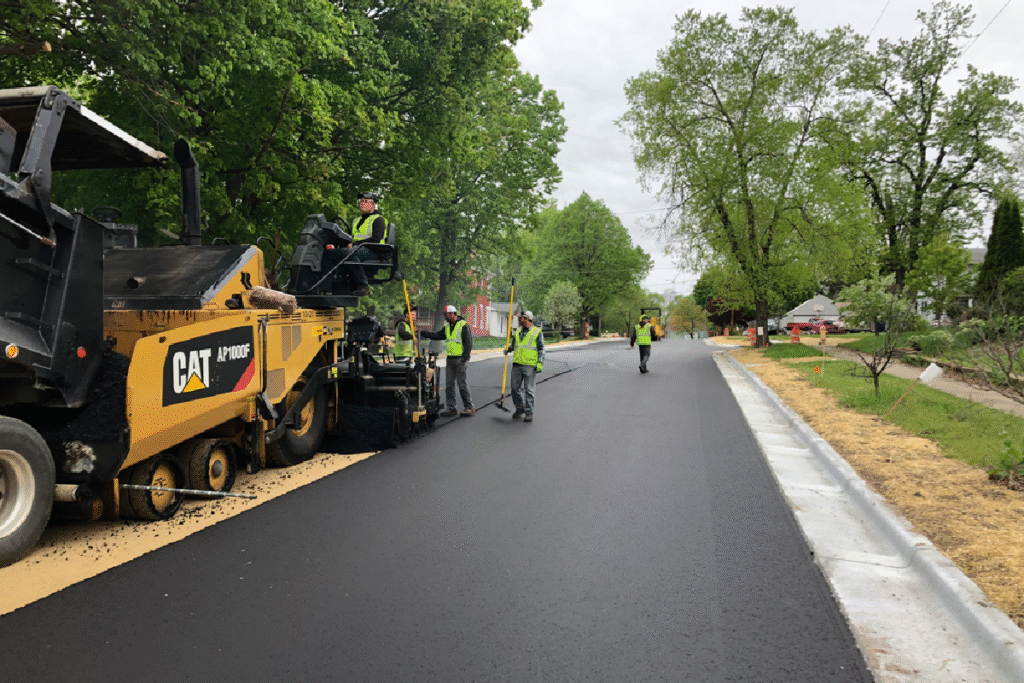
Extending Pavement Life for a Municipal Road Network Through Strategic Asphalt Resurfacing
Client: City of Brookhaven Public Works Department
Project Scope: Resurfacing and rehabilitation of 15 miles of heavily trafficked municipal roads
Location: Brookhaven, USA
Duration: 8 months
Background
The City of Brookhaven faced rising maintenance costs and declining pavement conditions across its main road network. Increased traffic load from commercial development, combined with harsh winter freeze-thaw cycles, had accelerated asphalt deterioration, leading to cracks, potholes, and uneven surfaces.
Traditional patchwork repairs were no longer cost-effective, as the same trouble spots reappeared within months. The city needed a sustainable, budget-friendly solution to extend the life of its asphalt roads without the expense of complete reconstruction.
Challenges
- High Traffic Volume – The roads served over 18,000 vehicles daily, requiring minimal disruption during resurfacing.
- Severe Surface Distress – Multiple areas showed deep alligator cracking, rutting, and base failures.
- Budget Constraints – The city had to achieve the maximum life extension at the lowest possible cost.
- Weather Limitations – The project had to be completed before the onset of winter to avoid delays and material quality issues.
Solution
The chosen approach was strategic asphalt milling and overlay, combined with targeted base repairs. The project followed a multi-phase strategy:
- Pavement Assessment – Engineers performed a full network condition survey using ground-penetrating radar and surface evaluation scoring.
- Milling Process – Damaged top layers were milled to a depth of 2 inches, removing oxidized and cracked asphalt while preserving the base where possible.
- Full-Depth Patching – Areas with base failures received full-depth reclamation with stabilized aggregate and binder course.
- High-Performance Overlay – A polymer-modified asphalt mix (PG 64-28) was applied to provide improved rutting and crack resistance.
- Crack Sealing & Edge Drainage – Post-overlay maintenance included sealing construction joints and improving roadside drainage to prevent future water infiltration.
Traffic management plans included nighttime milling and paving in high-traffic zones to reduce commuter disruption.
Results
- Extended Pavement Life by 12–15 Years – The overlay significantly delayed the need for full reconstruction.
- Reduced Maintenance Costs by 40% – Fewer recurring pothole repairs and emergency maintenance calls.
- Improved Ride Quality & Safety – Pavement smoothness index improved by 45%, reducing vehicle damage claims.
- On-Time, On-Budget Delivery – Project finished 3 weeks early, under the allocated budget.
Key Takeaways
- Strategic milling and overlay can be a cost-effective alternative to full reconstruction for moderately damaged asphalt roads.
- Nighttime work scheduling reduces public inconvenience on high-volume routes.
- Proper drainage improvements are critical to preventing premature pavement failures.