
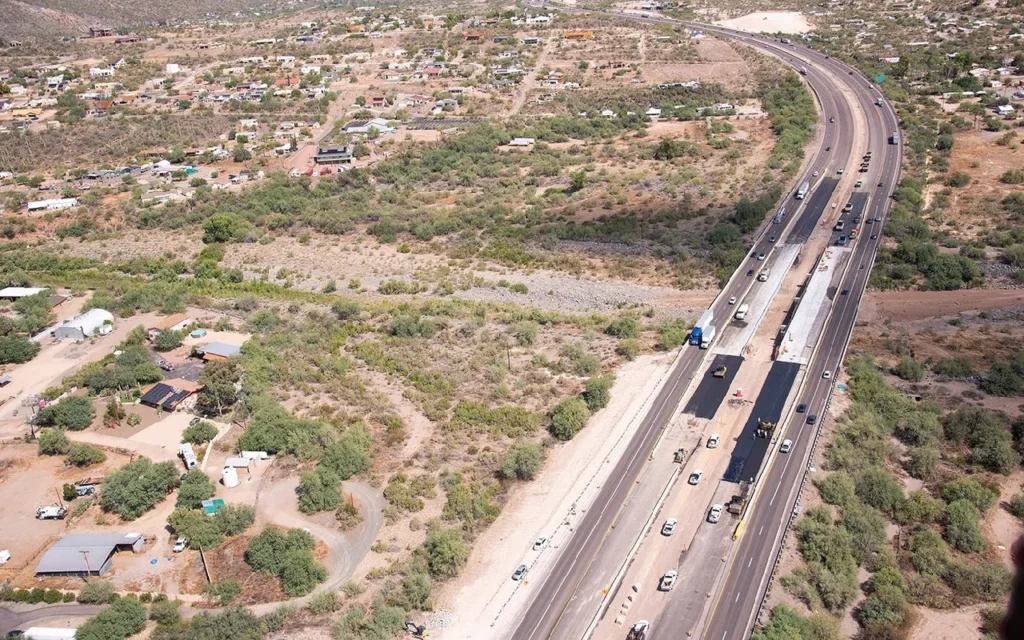
Arizona Department of Transportation Advances Ambitious Multi-Million Dollar Highway and Bridge Upgrades Across Greater Arizona
The Arizona Department of Transportation (ADOT) is spearheading a series of expansive transportation infrastructure projects throughout Greater Arizona as part of its ongoing 2023-2027 Five-Year Transportation Facilities Construction Program. These projects, intensifying through August 2025, are designed to modernize critical corridors, improve safety, and accommodate both rising commuter volumes and commercial freight traffic.
Among the focal points in ADOT’s current portfolio is the enhancement of State Route 202 Loop (SR 202L) in Maricopa County. Spanning approximately 9.5 miles between Guadalupe Road and Santan Village Parkway, this corridor expansion includes lane widening, interchange improvements, and critical bridge deck rehabilitations. The project aims to alleviate growing congestion while facilitating smoother connections to Phoenix’s expanding urban hubs.
Further significant investments target pavement replacement and bridge enhancements across major interstate and US highway routes. For example, a notable $137 million project aims to widen Interstate 10 south of Phoenix, specifically from the Gila River Bridge to Gas Line Road, enhancing this vital east-west artery. Similarly, $110 million is allocated to the widening of State Route 260 east of Payson in the Lion Springs area, improving traffic flow and safety on this scenic but heavily utilized route.
The Interstate 17 corridor, particularly from Sunset Point to State Route 69, is undergoing $240 million of expansion work aimed at increasing capacity and reducing bottlenecks that impact traffic between Phoenix and northern Arizona. These upgrades include adding lanes, modernizing interchange designs, and leveraging technological innovations such as intelligent transportation systems (ITS) that monitor traffic conditions and optimize signal timings for improved safety and efficiency.
ADOT’s pipeline further features strategic bridge replacements including a $66 million project to replace the Colorado Bridge on Interstate 10 at the California border, executed jointly with CalTrans to enhance interstate commerce and travel.
To address safety and operational efficiency beyond lane expansions, ADOT is proactively investing in intersection improvements, rest area upgrades, and the deployment of smart technologies like updated traffic signals and enhanced roadway signage. These improvements aim to reduce accident rates and provide better information to travelers navigating complex routes.
Public involvement remains central to ADOT’s approach. The agency is conducting ongoing outreach, including public hearings and digital engagement forums, to incorporate community feedback and keep stakeholders informed about project timelines, detours, and expected impacts. This transparent approach aids in mitigating construction disruptions and promotes collaborative progress toward long-term transportation goals.
Moreover, these projects underpin Arizona’s broader economic development strategy by improving freight mobility on key commerce corridors that link local businesses and industries to national and international markets. Given that over $300 billion in goods traverse Arizona annually, these infrastructure upgrades are vital to maintaining the state’s economic competitiveness.
In addition to road expansions and safety improvements, ADOT is also advancing airport infrastructure projects, including enhancements to the Grand Canyon National Park Airport, further solidifying Arizona’s multimodal transportation infrastructure.
As ADOT advances these projects through 2025, the agency balances rapid infrastructure delivery with sustainability goals by adopting environmentally sensitive construction practices, minimizing emissions through traffic management during construction, and ensuring that materials and techniques support long-term environmental stewardship.
These coordinated efforts reflect ADOT’s commitment to providing safe, efficient, and sustainable transportation solutions that meet the demands of Arizona’s growing population and evolving economic landscape.