
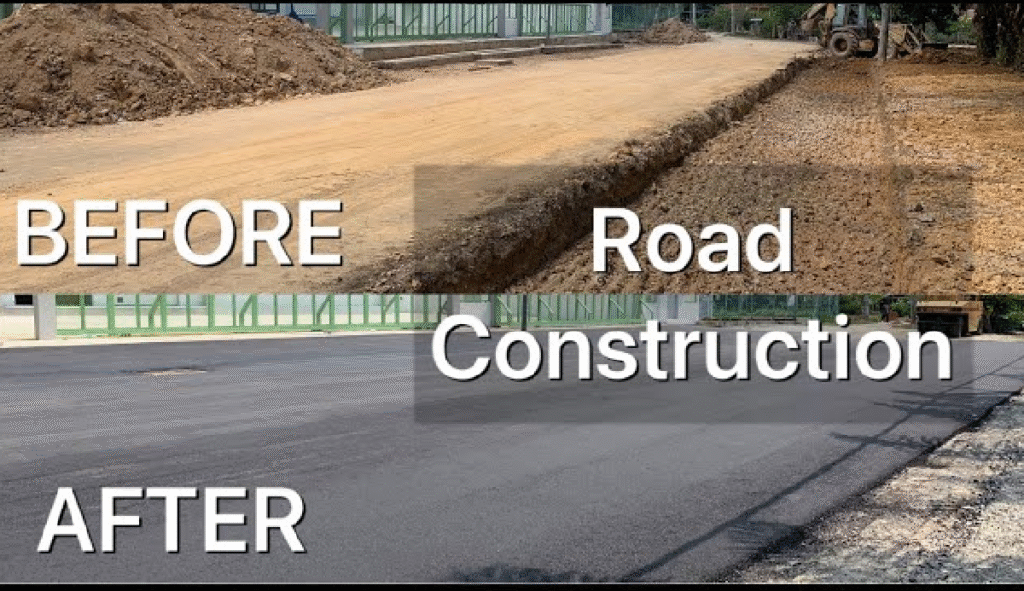
How to Build a Durable Asphalt Road: A Step-by-Step Construction Guide
Why Durability Matters More Than Ever
Building roads isn’t just about laying down asphalt and calling it a day. In 2025, road durability is more critical than ever due to increasing traffic volumes, extreme weather events, and higher infrastructure expectations. When a road fails prematurely, it disrupts traffic, costs money, and erodes public trust. That’s why understanding how to construct an asphalt road that can withstand time and stress is vital for contractors, municipalities, and developers alike.
This blog walks you through every major step of building a long-lasting asphalt road—from site prep to final compaction—while highlighting modern materials, technology, and best practices that define excellence in today’s pavement construction.
Step 1: Planning and Surveying the Site
A strong road starts with a strong plan. Before construction begins, engineers must conduct a thorough site survey to understand topography, soil conditions, and drainage needs. This phase includes:
- Geotechnical testing to assess soil stability
- Traffic analysis to determine expected vehicle loads
- Drainage studies to avoid water pooling or erosion
Modern tools like drone mapping and 3D modeling make this step more precise and predictive than ever before.
Step 2: Excavation and Subgrade Preparation
Once planning is complete, the ground must be cleared and leveled. This involves removing vegetation, debris, and unsuitable soil. Then, the subgrade—the foundation of the road—is compacted and graded to ensure a solid base.
🛠️ Why it matters:
The subgrade supports the entire road structure. If it’s unstable, the asphalt will eventually crack or sink. In wet areas, stabilization techniques like adding lime or geotextile fabric may be used.
Step 3: Installing the Base Layers
With the subgrade ready, the next step is to lay down base materials like crushed stone or gravel, which provide load distribution and improve drainage. This is called the aggregate base course (ABC).
Key considerations:
- Use properly graded aggregate for even compaction
- Apply water and roll in layers to avoid air gaps
- Check density with tests like the nuclear gauge method
For extra-heavy-duty roads, a sub-base layer may be added for reinforcement.
Step 4: Applying Binder and Tack Coats
Before laying asphalt, a tack coat is applied between layers to help them bond. Think of it as the glue that holds each asphalt layer together. A prime coat may also be added on top of the base to prevent moisture infiltration.
Modern binder materials often include:
- Polymer-modified bitumen for enhanced durability
- Rejuvenators to improve bonding with recycled materials
These enhancements improve layer adhesion, reduce cracking, and increase pavement life.
Step 5: Laying the Asphalt Layers
This is where the road starts to take form. Asphalt is laid in one or more courses (layers), depending on the expected traffic and design. Each layer has its role:
- Base course: The thickest layer, providing structural strength.
- Intermediate/binder course: Distributes loads between base and surface.
- Surface course: The top layer, which faces the elements and traffic.
Modern mix designs include:
- Hot Mix Asphalt (HMA): Best for strength and high-traffic areas.
- Warm Mix Asphalt (WMA): Environmentally friendly, produced at lower temperatures.
- Stone Matrix Asphalt (SMA): For premium durability and skid resistance.
Each layer is laid with paving machines and compacted while still hot using vibratory rollers.
Step 6: Compaction – The Make-or-Break Phase
Even the best asphalt mix will fail without proper compaction. This process removes air voids and ensures the material binds correctly. Poor compaction leads to raveling, rutting, and premature failure.
Modern compaction techniques in 2025 include:
- Intelligent Compaction (IC): Sensors and GPS monitor density in real time.
- Rolling patterns tailored to the material and temperature
- Thermal imaging to check for uniformity
Road builders now use real-time data to achieve optimal density with fewer passes.
Step 7: Final Touches and Quality Control
Once compacted, the road undergoes final inspections and quality checks, including:
- Smoothness testing with profilographs
- Density verification through core sampling
- Skid resistance tests for safety compliance
Proper striping, guardrail installation, and drainage inlets are also completed to bring the road up to operational standards.
Tips for Long-Term Durability
Building a durable asphalt road doesn’t stop after construction. You need to plan for:
- Regular maintenance like crack sealing and surface rejuvenation
- Timely overlays to preserve integrity
- Monitoring traffic patterns to plan upgrades
Smart road sensors can now provide alerts for load strain, temperature shifts, and surface deterioration—enabling proactive rather than reactive maintenance.
Why This Matters in 2025
In the age of smart cities and climate-resilient infrastructure, road durability isn’t a luxury—it’s a necessity. Every poorly constructed road adds to maintenance budgets, traffic congestion, and public dissatisfaction. But roads built with attention to foundation, material quality, bonding, and compaction last longer, perform better, and save money in the long run.
Asphalt continues to lead because of its flexibility, speed of construction, and adaptability. When done right, an asphalt road isn’t just strong—it’s smart, sustainable, and built for the future.